
How Clay-Hosted Lithium Basins Form
Basin Architecture, Structural Controls, and Why Continuity Matters
1. Basin-Scale Setting: Why Closed Basins Matter
Clay-hosted lithium systems are most commonly associated with internally drained basins in arid to semi-arid climates¹. In these settings, water flows inward but lacks external outflow. Evaporation exceeds discharge, allowing dissolved elements — including lithium — to accumulate rather than disperse.
In western North America, many such basins formed during Basin and Range extension or within caldera-related collapse structures¹. Faulting creates accommodation space, and continued subsidence permits thick sediment accumulation over millions of years.
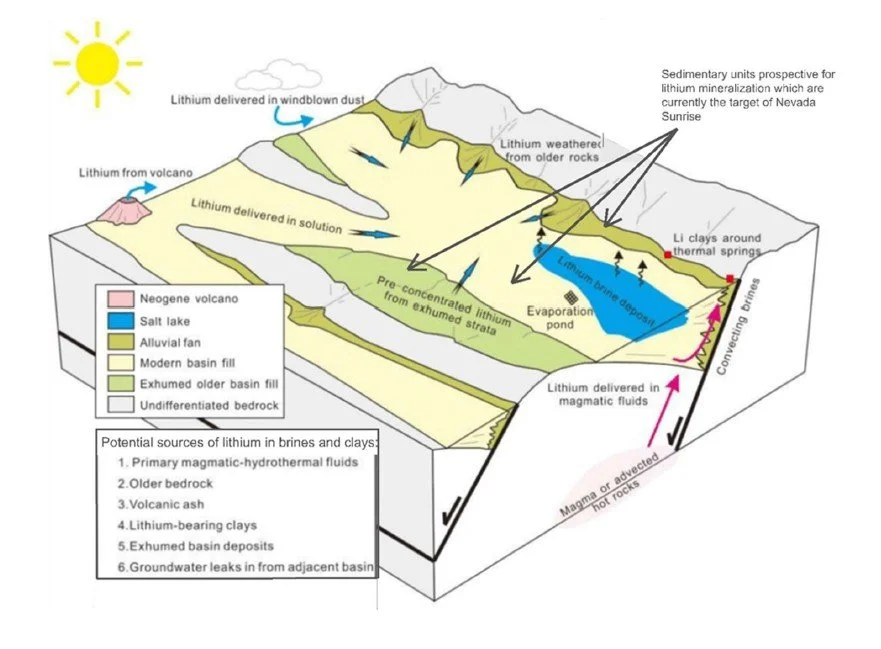
Schematic Deposit Model for Lithium Brines (Bradley, 2013)
Technical Context
USGS deposit models describe lithium-bearing lacustrine clay deposits forming in closed basins of tectonic or caldera origin, typically within arid climates where evaporative concentration enhances lithium retention¹. Structural depressions — including half-grabens and caldera-related basins — provide the accommodation space necessary for sustained sediment accumulation.
Hydrologic closure improves lithium retention efficiency; more open systems may reduce concentration potential through dispersal¹.
Exploration Implication
Architecture precedes chemistry.
Before evaluating grade, the key question is whether the basin framework is capable of trapping and retaining lithium over geological time.
2. Lithium Source: Volcanic Input and Alteration
Most major clay-hosted lithium systems are genetically linked to felsic volcanic material — particularly rhyolitic ash and tuffs enriched in incompatible elements². These materials are deposited within basins or surrounding highlands and subsequently altered through weathering, diagenesis, or hydrothermal processes.
Lithium released from volcanic glass becomes mobile in alkaline basin waters and can migrate toward depocenters.
Technical Context
In the McDermitt Caldera (host to the Thacker Pass deposit), lithium is interpreted to derive from alteration of volcanic glass in caldera-related tuffs and sediments, with enrichment occurring within a closed hydrologic system². Recent USGS research further suggests that magmatic fluids may have contributed additional lithium in some systems³.
The relative importance of closed-system diagenesis versus hydrothermal input remains an active area of research³.
Exploration Implication
Mapping volcanic stratigraphy and understanding alteration pathways can materially refine targeting prior to extensive drilling. Lithium systems are as much about source and fluid history as they are about sediment thickness.
3. Clay Formation and Lithium Fixation
For lithium to form a clay-hosted deposit, it must become incorporated into stable mineral phases. In low-energy lacustrine environments, fine-grained sediments accumulate and authigenic clay minerals form.
Lithium becomes hosted primarily within smectite-group clays and, in some systems, within lithium-bearing illite-type clays².
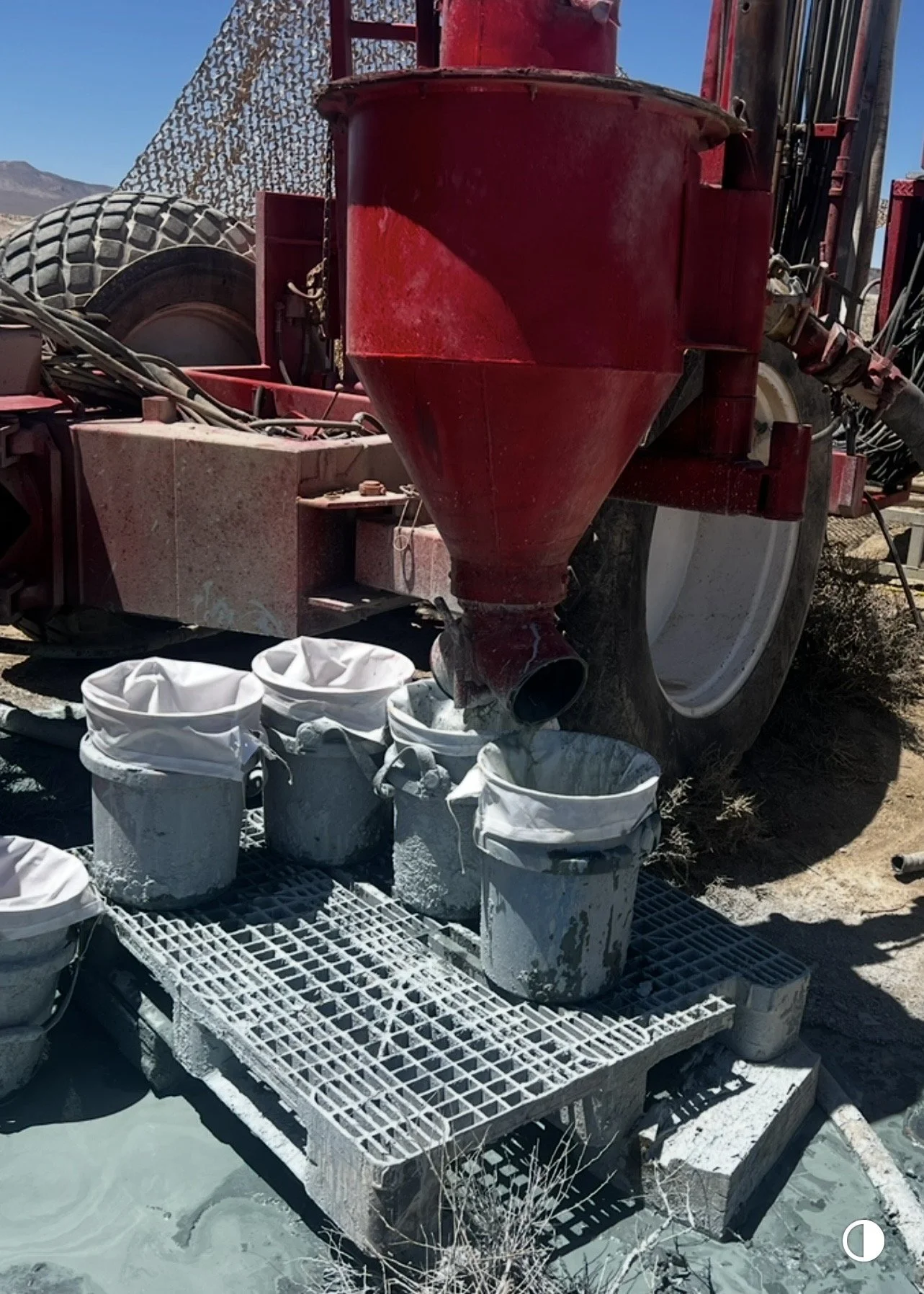
Picture of Lithium bearing clays being collected at a drill rig
Technical Context
At Thacker Pass, lithium occurs in two principal clay types:
Smectite-group clays (often hectorite-like)
Illite-type lithium-bearing clays described as mineralogically similar to tainiolite²
Lithium may be adsorbed at exchange sites or incorporated structurally within clay lattices during alteration and diagenesis. Clay mineral transitions during burial can influence lithium distribution and processing characteristics.
Exploration Implication
Clay mineralogy affects metallurgy, recovery assumptions, and economic modeling. Geological understanding informs processing strategy early in project development.
4. Structural Controls and Basin Architecture
Clay-hosted lithium deposits are not random accumulations of enriched sediment. They are the expression of long-lived structural systems. Before lithium can be fixed in clay, before grade can accumulate, and before tonnage can be modeled, there must be a basin capable of holding sediment — and holding it for a very long time. Basin architecture determines that capability.
In extensional tectonic settings, normal faulting creates structural depressions that form accommodation space — the volume available for sediment to accumulate. In half-graben systems, a master fault defines one margin of the basin, and progressive subsidence allows thick sediment packages to develop toward the structural low. Over time, fine-grained lacustrine sediments preferentially accumulate in these depocenters, where low-energy conditions favor clay formation and preservation. In caldera-related systems, collapse structures similarly generate deep structural troughs that become long-lived sediment traps. It is within these structural lows that lithium-bearing clays most consistently develop.
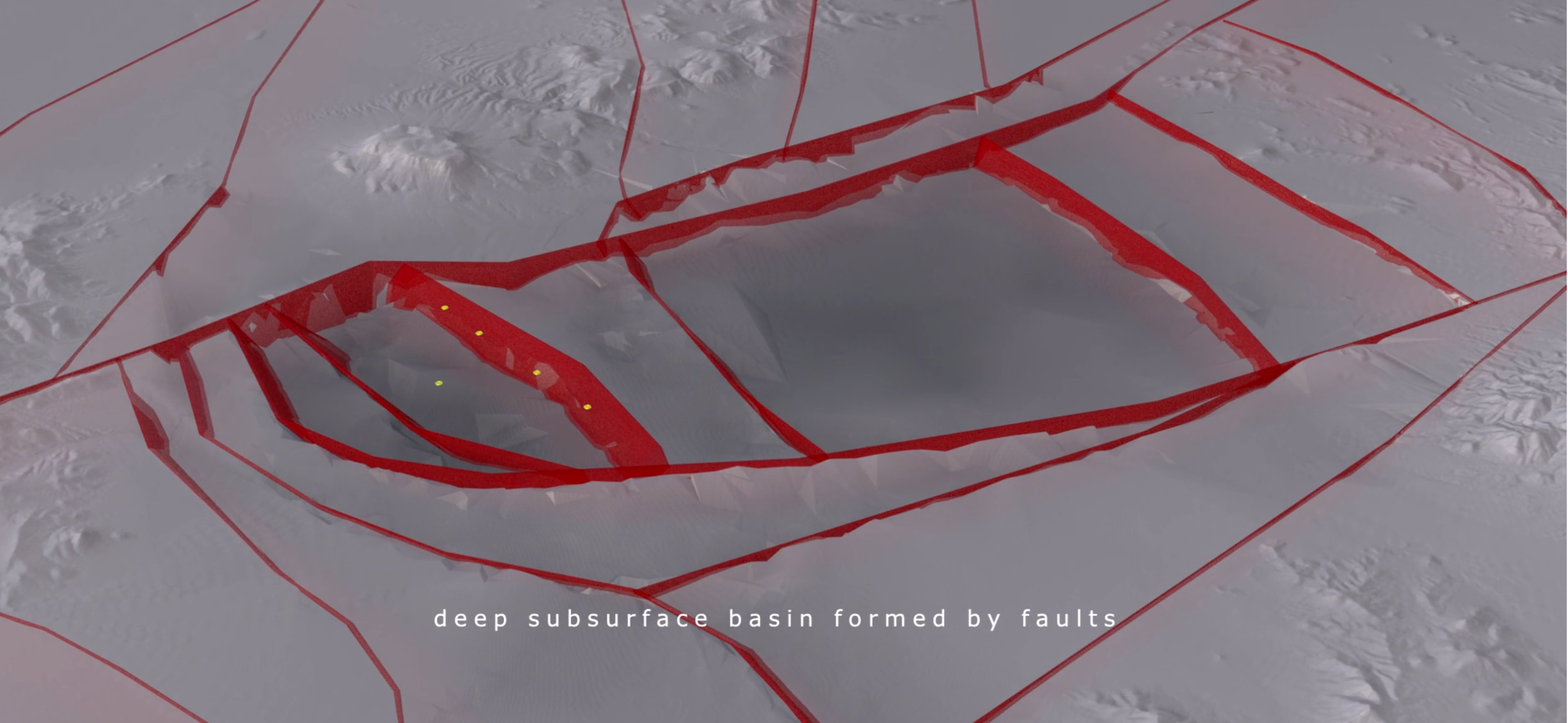
3D model of structural interpretations depicting two structural depressions within a basin. (Nevada Sunrise, Gemini Project Website)
Subsidence history matters as much as geometry. If subsidence keeps pace with sediment supply, thick lacustrine sequences can accumulate and remain preserved. If tectonic stability allows repeated lake cycles to persist, lithium has time to be mobilized, transported, and incorporated into clay minerals. Conversely, basins that uplift too quickly, leak hydrologically, or experience significant erosional stripping may fail to preserve substantial clay packages regardless of volcanic input.
Structural controls also influence continuity. Growth faulting during deposition may cause stratigraphic thickening toward the master fault, producing predictable geometry that can be tested through drilling. Later structural reactivation may compartmentalize the basin, offset clay horizons, or create localized thickness variations. Understanding these structural relationships allows exploration to move from intercept-driven interpretation to system-driven targeting.
A thick drill intercept in isolation provides limited information. A drill intercept positioned within a coherent structural framework provides context. Targeting therefore begins not with grade, but with basin interpretation. Structural lows, fault-controlled depocenters, and zones of sustained accommodation space represent the highest-probability areas for thick, laterally continuous clay development. Geophysical data, stratigraphic modeling, and fault mapping are not supplemental tools — they are foundational components of exploration strategy in these systems.
In clay-hosted lithium deposits, architecture is not background geology. It is the controlling variable
Technical Context
Half-graben and caldera-related basins commonly display asymmetric geometry with stratigraphic thickening toward structural lows¹. Syn-depositional subsidence can influence clay accumulation patterns. Post-depositional faulting may compartmentalize or offset mineralized horizons.
Integration of drilling, mapping, and geophysical data (e.g., gravity surveys defining basin depth) is typically required to constrain basin geometry.
Exploration Implication
Single drill holes do not define systems.
A structural model does.
Continuity must be demonstrated across meaningful distances before scale can be inferred.
5. Continuity vs. Intercepts
Clay-hosted lithium systems are fundamentally geometry problems. A thick interval at favorable grade provides limited insight without lateral persistence.
Scale emerges from continuity.
Technical Context
Resource evaluation relies on stratigraphic persistence, lateral correlation length, and structural coherence. Variability in depositional facies or basin architecture can produce lateral grade changes or thinning.
Exploration Implication
Step-out drilling tests system extent.
Infill drilling increases confidence.
Strategic sequencing depends on architectural interpretation rather than isolated assays.
6. Exploration Strategy and Economic Framing
Clay-hosted lithium deposits are generally large-tonnage systems where economics depend on scale, continuity, overburden thickness, processing assumptions, and infrastructure — not solely on peak grade.
Cutoff grades are economic parameters that shift with lithium pricing and processing cost.
Key Considerations
Basin depth and structural geometry influence total tonnage potential.
Hydrologic and alteration history influence grade distribution.
Clay mineralogy influences processing cost.
Structural continuity influences predictability of expansion.
Geology ultimately drives economic framing.
7. Common Misunderstandings
Clay-hosted lithium deposits differ fundamentally from brine systems in formation and extraction.
High ppm values do not automatically equate to economic scale.
Shallow mineralization does not guarantee lateral continuity.
Basin size does not ensure mineralized footprint.
System understanding reduces early-stage misinterpretation.
References
USGS Deposit Model for Lithium in Lacustrine Clays (Model 7C), internally drained basins of tectonic or caldera origin, arid climate concentration.
Thacker Pass NI 43-101 Feasibility Study Technical Report — mineralogy and lithium host phases (smectite/hectorite-like and illite/tainiolite-like).
USGS (2025) “Lithium from Magma to Mine” — magmatic and hydrothermal contributions to McDermitt Caldera lithium enrichment.
